Friday, March 30, 2012

Justitie Palais

I have already mentioned the new court house in Antwerp, the one that has resemblance with nostalgic newspaper cones. This package was used by french fries sellers, was made of newspapers and became a symbol of good old days in Flanders. I don't know if I like Justitie Palais or not, in any case I always feel a slight discrepancy between design and function. In our post-modernistic times 100 hundred year old rules about design that should follow function are not meticulously observed anymore. It looks more like an airport or an exhibition center to me. A friend of mine who saw photos taken yesterday night thought that it is a train station. Some photos are here (not mine). I haven't done anything with my photos yet, not good at it)so I place them as they are.


on the opposite side of the square

The last stop of the tram is under the staircase of the building. It is quite windy on the stairs leading to the palace. Funny thought : it's good that the judges don't wear wigs in Belgium.


Femida
Antwerp at night


My tripod wouldn't turn the camera for making a vertical shot but I couldn't pass these
beautiful Art-Nouveau facades without taking some photos


Enough concrete

My concrete essay has been finished (I hope) but shortened to readable size and is missing some interesting stories I first planned to insert. I haven't written about a girl with an oar which was a symbol of a socialist way of life and a source of numerous jokes, whose ugly concrete copy could be found in any park. What later became a metaphor of Soviet propaganda was first created by Ivan Shadr as a beautiful sculpture of a slender girl standing nonchalantly in the middle of a huge recreational park in the centre of Moscow.


There were however two problems with the girl that caused her exile to a far-away town Lugansk. She was made of a very light cement variety, white coloured body looked so shockingly realistic. The second problem was her size. 8 meters of sexually appealing nudity in the middle of the park where citizens were supposed to relax and do sports was a challenge to socialist morals. The next version of "The girl with an oar' was grey and much smaller in size. In the meantime the idea was cloned and 'The girl with an oar" became present in all the parks but she was given more muscles and she was dressed.
They loved big sculptures back in the Soviet Union, they still love them in Russia, the bigger the better. A huge monument to Artem by Kavaleridze created in the 1927 (photo wikipedia).


The second story was about concrete German bunkers which can be found all over Belgium. One of the first examples of modular construction, they were built from prefab elements in a very short period of time. Once sinister they are now becoming a part of the nature turning into stones covered with moss. Water dropping through the ceilings of bigger underground bunkers forms stalagmites that crack under the feet as you walk along the corridors. Left unattended they will soon lose their connection with the most tragic years of European history. Some of the bunkers were demolished because people didn't want to see this reminder of war but soon they found out that the price of demolition was too high and it's cheaper to change the attitude towards them. I know bunkers transformed into chicken and garden sheds, electricity high-voltage cabins and this climbing wall in Sint-Katalijne-Waver (photo-flickr)


I also didn't write about concrete war memorials and museums , concrete in interior design, concrete in photography and many other things, but it's time to say good bye))

Friday, March 2, 2012

Silent 'Sound wave'


Artists often  use a finished product for the piece of art,  ‘found objects’ for example. No matter which object you choose, the original material will be present, sometimes inconspicuously.

The exhibition at the museum of Art and Design in 2008 featured this installation of  Jean Shin, made of old vinyl plates. It looks like a Hokusai picture, but the artist named  it  ‘Sound Wave’ underlying the connection between the object(plate), material(vinyl, still used in music industry) and the idea that the viewer would have looking at it. (photo NY Times)


Another thought-provocing installation of Jean Shin – ‘Chance city” where she built a city of ruined dreams and lost hopes by using discarded lottery tickets.

The sheer amount of similar objects could make a strong impression, especially when artist uses these objects in an unexpected way.

'Long-term parking' by Lorent Mutzig 


Another example, the installations of Matej Kren, and Tom Bendtsen  known for their book-staking art.  Being a bookish person I was greatly impressed by the massiveness of the paper-made construction and the huge amount of books gathered together for this purpose. Strangely, this use of books didn’t arouse any protest inside, though in my parents’ home no book could have been treated disrespectfully. No page could have been thumbed with a wet dirty finger and no pencil was allowed for making notes on the margins.  The fact that all the  precious books were removed from the circulation and degraded to the state of bricks didn’t bother me anymore when I saw familiar covers stacked in the forms of pillars and walls. The associative sequel went all the way from paper- (light, perishable)-book (source of knowledge and emotional experience)-stack of books (heavy, very heavy) to a massive construction (stability, thick walls) and back to thousands of books and amount of unattainable knowledge hidden in this unusual building looking like a medieval fortress.  


 www.jeanshin.com
http://www.matejkren.cz
http://www.tombendtsen.com/


Wednesday, February 29, 2012

Architectonic walls in Atomium

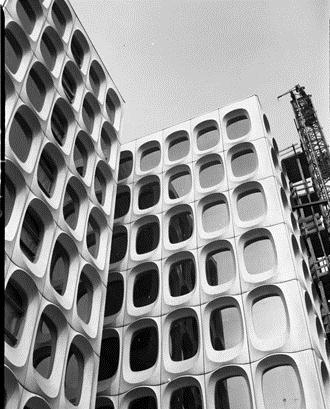
While finishing my essay about concrete I found out that there is an exhibition in Brussels, to be more precise in Atomium, this bizarre symbol of Belgian capital. Post war architectonic facades that I was looking for in my neighbourhood are the central subject of this exhibition.  The only wall I found was this, near the back door of the local primary school.


From the exhibition:


Konstantin Brodsky's building


Marcel Breuer, Torrington building, Nijvel


Strangely all of the 8  houses they feature are in Brussels or in Wallonia, French-speaking part of Belgium. 


Monday, February 27, 2012

Concrete- physical characteristics

I am not much of a writer when I am not excited about the subject. Physical characteristics subject doesn't excite me a bit. Still it's necessary to know what this material is capable of. Being practical, cheap and therefore ubiquitous, it is often can be seen in a pretty bad state of decay. Eroded surfaces with rusty metal bars that appear from the cavities and nasty cracks  gives us the idea that this material lacks durability and that it is not trustworthy.  The critics have point, it doesn't age gracefully.


Comparatively recent concrete buildings ask for more maintenance than medieval castles. The news about Lloyd Wright's textile houses multimillion repair bills and pieces of Russian constructivism falling down on pedestrians heads do not add respect to the material. On the other hand it has so much potential that modern technology doesn't give up on it and  constantly works on it's improvement. The compression strength of concrete is high, tensile strength can be improved by adding reinforcement -steel bars and fibers.
Steel reinforcement increases tensile strength to such an extent, that concrete suspension bridges became a part of our environment since 1889. The use of reinforced concrete instead of iron made the construction much cheaper. The engineering science at the end of the 19th century and the beginning of the 20th was based on quite a romantic idea of mathematical beauty of the construction. Mathematically clever and correct meant beautiful. The complicated buildings of that period, especially bridges, are fascinating examples of human engineering genius and beauty. The breath-taking examples of modern and old bridges made of concrete and steel prove that utility can be beautiful.
The Akashi Kaikyo Suspension Bridge is the longest suspension bridge in the world


The word "Art" is present in all the descriptions of  great bridges.
"The Millau Viaduct takes its place among our most shining works of civil engineering," Chirac said while unveiling a commemorative plaque at the bridge. "[It] is a magnificent example in the long and great French tradition of audacious works of art, a tradition begun at the turn of the 19th and 20th centuries by the great Gustave Eiffel." An architectural critic echoed: "an epic work of art [with] an ambition far beyond utility." Photo borrowed from this site
When we travel by car from the South of France back home I always want to take this road because of the Millau viaduct.

Sunday, February 26, 2012

Every thing that is human

In her artist statement Jenine Shereos writes about her work "The Breath"

Breath(e) is an exploration of the 'permeable boundary' that exists between our physical bodies and the world around us. There is a literal exchange that occurs within every inhale and every exhale.

I can't help thinking, that this  text was written post factum and that the inspiration for making this piece was an Anatomy atlas. I like the intricate network of blood vessels that looks like a system of roots going deep in the soil which makes the figure look like a tree. And Jenine's little leaves made of human hair. Very unusual material which definitely make some people shudder in disgust, unlike Victorians we don't exchange locks of hair with lovers and don't wear brooches woven from hair of dead people.


However parts of human bodies were not wasted in older, less squeamish cultures. Bones, hair, sculls and pieces of mummified corpses were used for rituals and decorative objects together with horns, teeth and claws of hunters trophies. Some examples from MAS museum, Antwerp.


In Tibetan tradition, a body without soul was worthless, the dead were left in the mountains to feed scavenges. Bones served as offering vessels musical instruments, drums(sculls) and flutes(thigh bones). Smaller bones were connected together to form strings which then were fixed on the priests waists as a sort of aprons.


This decorated fake head from Latin America was made of human bones and feathers and was used for burial ceremonies.


The photo of the decorative scull of unidentified animal, probably cow (human sculls are still taboo these days) was taken on the same day I visited the MAS museum.


Whatever was the artist's inspiration for this piece, bone is just a beautiful material, no wonder  ivory was extremely popular.


Marc Cordenier bone sculptures


Saturday, February 25, 2012

Middelheim Museum

Middelheim museum in Antwerp houses an extended collection of the 20th century sculpture. I was curious how many concrete pieces they have. There were some objects that looked like concrete but when I came closer and touched them and scratched them gently with my nail, and knocked lightly with my knuckles, they turned out to be metal or natural stone. I managed to identify only four (!) concrete pieces and was absolutely sure but 2 out of four were 'granite stone' according to internet catalogue. Couldn't believe my eyes. Granite stone 'Column pavilions' by Charles Vandenhove